Will AI agents be using crypto?

At the same time, interest is growing on the open side of the market in agent frameworks and open systems such as OpenClaw, which has quickly gained attention as a flexible orchestration layer for AI agents. It is becoming increasingly clear that we are moving toward a world in which agents become commonplace, however distant that may still feel to some people today.
By now, most people understand that AI models and agents can work with text and code. But what happens when these systems need to operate fully independently, for example to order your groceries? Or to access external services and systems on their own?
That is exactly where crypto starts to come into view. Not because every AI problem needs a token, but because traditional financial rails are poorly suited to software that executes transactions autonomously.
This view is now being voiced openly by prominent figures in the market. Brian Armstrong recently argued that “very soon” there will be more AI agents than humans making transactions, and that while those agents cannot open a bank account, they can own a crypto wallet.
The phrasing may be intentionally sharp, but the underlying observation is difficult to ignore. The existing financial system is built around human or legal entities. Agents are neither. In that sense, a wallet is far closer to the logic of software than a bank account will ever be.
That is also why the conversation is shifting from vision to infrastructure. In early 2026, Coinbase launched Agentic Wallets, wallet infrastructure built explicitly for AI agents, with integrations around x402 and the broader developer stack. The promise is quite concrete: agents can pay, earn and transact onchain independently. That may still sound niche, but it addresses a fundamental question within agentic AI: how do you allow software to carry out economic activity in a safe and programmable way?
Why this question matters now
The main reason is simple: agents are increasingly gaining access to tools, workflows and external systems. Anthropic itself describes how users are allowing Claude Code to operate more autonomously, with more advanced users reviewing each step less often and relying more frequently on auto-approval. Once that happens, an agent is no longer just an interface for information. It becomes an actor within digital processes. And an actor within digital processes quickly runs into transactions.
So the question is not only whether agents can do more technically, but also how they operate economically. An agent that exchanges value independently needs something that works globally, is programmable, does not depend on manual human approval, and can support small transactions. That is when blockchain suddenly becomes very interesting.
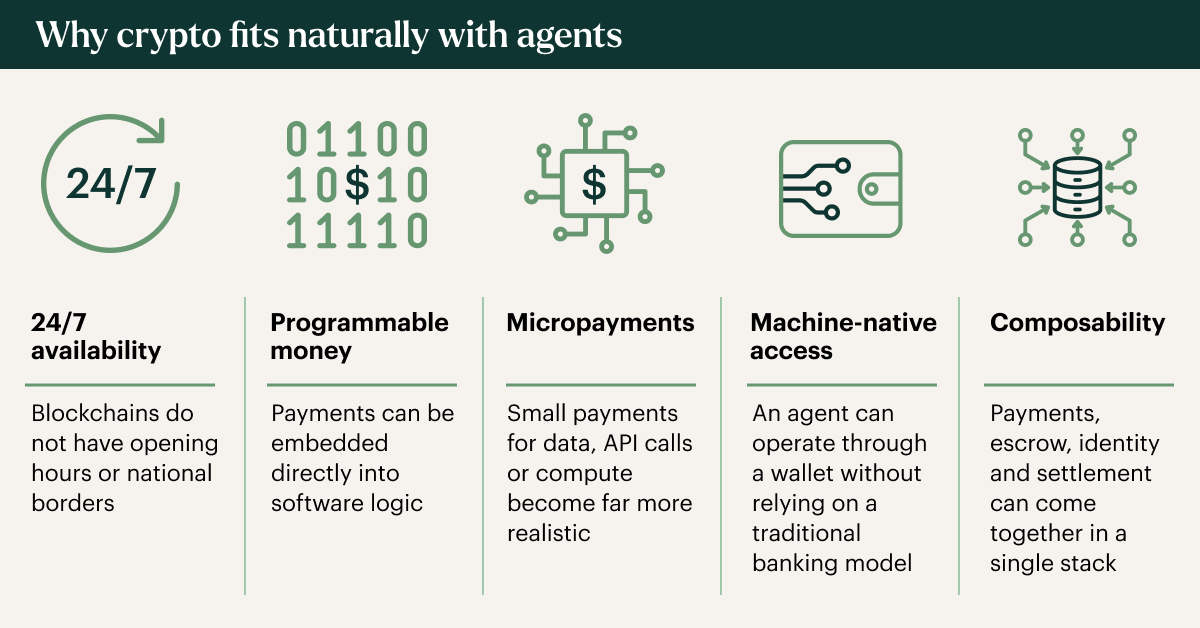
Why crypto fits naturally with agents
- 24/7 availability: blockchains do not have opening hours or national borders.
- Programmable money: payments can be embedded directly into software logic.
- Micropayments: small payments for data, API calls or compute become far more realistic.
- Machine-native access: an agent can operate through a wallet without relying on a traditional banking model.
- Composability: payments, escrow, identity and settlement can come together in a single stack.
These benefits map directly onto how agentic software is likely to function. Many agents will not make one large purchase. They will execute a stream of small decisions and microtransactions: paying for access to information, temporarily renting resources, combining digital services, or settling with other agents. In that context, programmable money is not just convenient. It is close to a requirement.
The market is already taking shape
Coinbase is the clearest example on the crypto side. With Agentic Wallets and the broader x402 direction, the company is positioning crypto not primarily as an investment object, but as an internet-native payment and transaction layer for software. That is a materially different framing from the old crypto story. The focus is shifting from speculation to infrastructure.
On the other side of the field, traditional payment providers are taking the same development seriously, but from a different angle. In March, Mastercard introduced Verifiable Intent, developed with Google as a standard for agentic commerce. The core idea is not payment itself, but proof: can an agent demonstrate that it is acting in line with the user’s original intent? That point is critical, because autonomy without verifiable permission will be difficult to scale across many commercial applications.
That is exactly where it becomes clear how crypto can play a role, without automatically being the entire solution. Crypto can serve as a strong settlement layer for agents. But a settlement layer alone is not enough. A trust layer is needed as well: identity, limits, authorisation, auditability and liability.
Is it all positive?
Anyone who frames this topic too enthusiastically misses the real level of difficulty. The main obstacle is not whether an agent can technically manage a wallet. The real obstacle is whether that agent can act safely, controllably and in an institutionally responsible way.
There are serious challenges as well
Security: agents can be misled, manipulated or pushed beyond their intended scope.
Liability: it remains difficult to determine who is responsible when errors occur.
Compliance: KYC, sanctions regimes and access rights do not naturally align with autonomous software.
Governance: user intent and the permitted scope of action must remain verifiable.
Operational control: more autonomy requires stronger guardrails and monitoring, not less.
These risks are not hypothetical. WIRED recently reported on research showing that OpenClaw agents were vulnerable to manipulation and could even be pushed into self-sabotaging behaviour. At the same time, Anthropic’s own documentation around Claude Code Auto Mode emphasises how important it is to configure permissions, classifiers and safety boundaries properly. That says almost everything. The market is moving toward greater autonomy, but the security question is growing just as quickly.
For institutional or professional use cases, that is where the real dividing line lies. Not every agent will need a wallet tomorrow. Not every workflow calls for onchain settlement. But in environments where software handles tasks independently, makes small transactions and combines services, crypto has a clear functional advantage over traditional rails, provided it is embedded within a robust layer of policy, security and control.
Conclusion
Perhaps the better question is no longer whether AI agents will use crypto, but what they will use it for and under which conditions. There is a strong chance that crypto will become the most logical transaction layer for part of the agent economy: programmable, global, continuously available and built for digital interaction. But that still does not make it a complete solution.
Without clear authorisation, governance and security, autonomous commerce remains too fragile for real scale. The most promising outcome is therefore not a world in which all agents simply move onchain, but one in which crypto evolves into the economic layer beneath agentic software, carefully bounded, verifiable and embedded in mature infrastructure.