ZK Series: The power of compounding returns

- What are compounding returns?
- Why consistency matters more than peaks
- An example calculation
- Why this matters in crypto
- Conclusion
Investing is not only about “high returns,” but about returns you can repeat consistently. That is where compounding comes in, often best described as returns on returns: you earn returns not only on your original capital, but also on the gains you have already built up. Over time, your capital grows on a larger and larger base, and time becomes a real accelerator.
What are compounding returns?
Compounding simply means that profits stay invested (or are reinvested), so the next period’s return is calculated on a higher amount. At first, the effect looks small, but as time passes it becomes increasingly powerful. This is the difference between linear growth and compounded growth.
Why consistency matters more than peaks
Compounding works best when returns are stable. Not because peaks have no value, but because large swings interrupt the growth path. Deep drawdowns require disproportionately large recoveries: after a loss, you need a much higher gain just to get back to where you started. After a 50% drop, you need a 100% gain to get back to break even. That is why steady growth often beats a volatile return profile, even when average returns look similar.
An example calculation
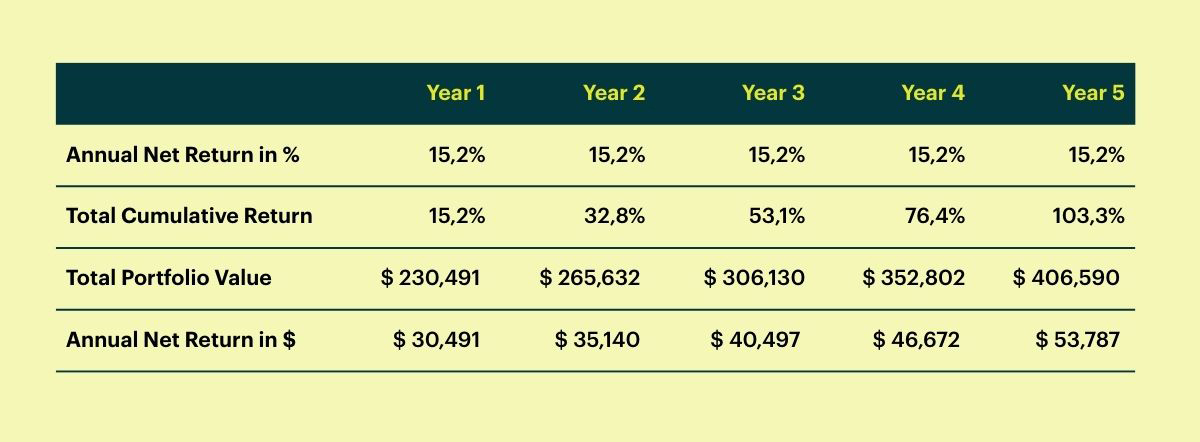
To make the impact of compounding returns tangible, we use an example based on the conditions of our ZK Fund, an initial investment of $200,000, and a gross monthly return of 2%.
After fund costs, this results in a net annual return of 15.2%. In the first year, this leads to a net investment result of $30,491.
If the investor chooses to reinvest these returns, the benefit of compounding begins to work. In that case, a net annual return of 15.2% would lead to a net investment result of $53,787 in the fifth year.
This example shows why compounding makes such a difference: once returns are stable, the effect builds more strongly over time. A 15.2% annual return can therefore double the investment over a five-year period.
Curious to see what these returns could do for your portfolio? Try the calculator via the button below.
Why this matters in crypto
Crypto trades 24/7, moves quickly, and experiences periods of extreme volatility. For many investors, the challenge is not only generating strong returns, but above all avoiding major drawdowns. That is exactly where compounding becomes interesting. Even if the returns may seem “low,” their consistency can make them an attractive long-term investment.
Conclusion
Compounding is one of the most powerful principles in investing, but it requires one thing: consistency. The more stable the return path and the stronger the risk management, the stronger the compounding effect becomes over time. In a volatile market like crypto, that can be the difference between a portfolio that spikes and retraces, and one that keeps building steadily.
With its Market-Neutral and High-Sharpe strategies, the ZK Fund aims to achieve an average gross annual return of 20-25%.
The Hodl ZK Fund fits within this framework. It applies hedge fund principles with a focus on market-neutral and high-Sharpe strategies, aimed at stability and risk-adjusted growth in crypto.
Want to learn more about the inner workings of the ZK Fund? We are hosting several ZK Knowledge Sessions in our office in Rotterdam. You can sign up via the button below. Not able to make it to our office? Or are there no more available dates? Then our specialists are ready for you in a personal (online) meeting.