Stablecoins in 2026



The stablecoin market has grown almost twelvefold since the end of 2020: from 27 billion dollars to 308 billion in August 2026. Reason enough to look more closely at that growth. In this article we will dive deeper into the basics of a stablecoin and how the asset has evolved to become a critical component in the financial system.

What stablecoins are, and which types exist
There are four main forms, and they differ mainly in what secures the peg.
Backed by cash and government securities. This is by far the largest category. The issuer holds reserves in dollars and short-dated (US) debt, and issues tokens against them. USDT from Tether and USDC from Circle work this way. The risk lies in the quality of those reserves and in whether they are genuinely available if many holders want to exit at once. Euro stablecoins exist too, but together they account for roughly 674 million dollars against a total stablecoin market of more than 300 billion.
Backed by other crypto. Here the backing sits on the blockchain itself, usually with a surplus: for every dollar issued, a dollar and a half of collateral is locked up, for example. That absorbs price swings, but it also makes the system sensitive to sharp falls in the collateral.
Algorithmic. This category tried to hold the peg with a mechanism rather than with a reserve as backing. In May 2022, TerraUSD lost its peg to the dollar and the token became almost worthless. Since then this form has barely played a role, and that is the most important lesson from the first ten years of this product: a promise of stability without backing is a promise that breaks at the moment it matters. This form generally offers more decentralisation, but confidence in it has been limited ever since.
Backed by a commodity. Usually gold. Small in size and a different product from the dollar variants, because the value moves with the gold price. It has attracted more interest in recent years, but from investors looking for exposure to gold.
The stablecoin market is also highly concentrated. In mid-2026 USDT stood at roughly 183 to 187 billion dollars and USDC at roughly 72 to 75 billion. Together that is around 83 percent of everything issued. And 98 percent of the entire market is pegged to the dollar.
From crypto trading to the real economy
Stablecoins emerged as a tool inside the crypto market. Anyone who wanted to avoid price risk between two positions could not simply step out into euros, and a stablecoin was the practical solution. For years that was virtually the only use.
That is shifting, and the reason is straightforward: for certain payments, stablecoins are simply faster and cheaper. An international transfer runs through several correspondent banks, takes one to several days and is hard to track. A stablecoin payment settles within minutes, at any hour, and the recipient can see it arrive.
That advantage is largest where the existing system works worst: payments between companies in different countries, paying suppliers and freelancers across borders, and remittances to countries with a weak currency or a slow banking sector. And that is precisely where use is rising. Of the stablecoin transactions that can genuinely be identified as a payment or transfer, an estimated 60 percent is business-to-business traffic.
The parties now stepping in say something about the stage this product has reached. In 2026, JPMorgan, Bank of America, Citi, Société Générale and Standard Chartered all have live products or public commitments. June and July brought a wave of new issuance: SoFiUSD as the first white-label stablecoin from a US national bank, USAT from Revolut US, Open USD from a consortium of more than 140 partners, and EURXT from Crédit Agricole via CACEIS on 1 July. In Europe, Qivalis was founded, a consortium that now counts 37 banks from 15 countries working together on a euro stablecoin. Its members include ABN Amro, Rabobank, ING, KBC, BNP Paribas, UniCredit, CaixaBank and Nordea. The consortium intends to operate under the supervision of the Dutch central bank and is aiming for a market launch in the second half of 2026, once the licence is in place. On the payments side, names such as Stripe, Shopify, Klarna, Deel and Visa are part of the infrastructure being built around it.
The growth in numbers
The size of the market is the easiest figure to follow, because it is simply the sum of everything issued.
- End of 2020: 27 billion dollars
- August 2025: 269.4 billion dollars
- April 2026, the peak so far: 321 billion dollars
- 13 August 2026: 308.0 billion dollars
That is growth of 14.3 percent in a year, and almost twelve times the size at the end of 2020. The fall from the April peak to August shows that this is not a straight line: the outstanding stock of stablecoins shrinks when investors take money out of the market on balance, or move into other crypto assets.
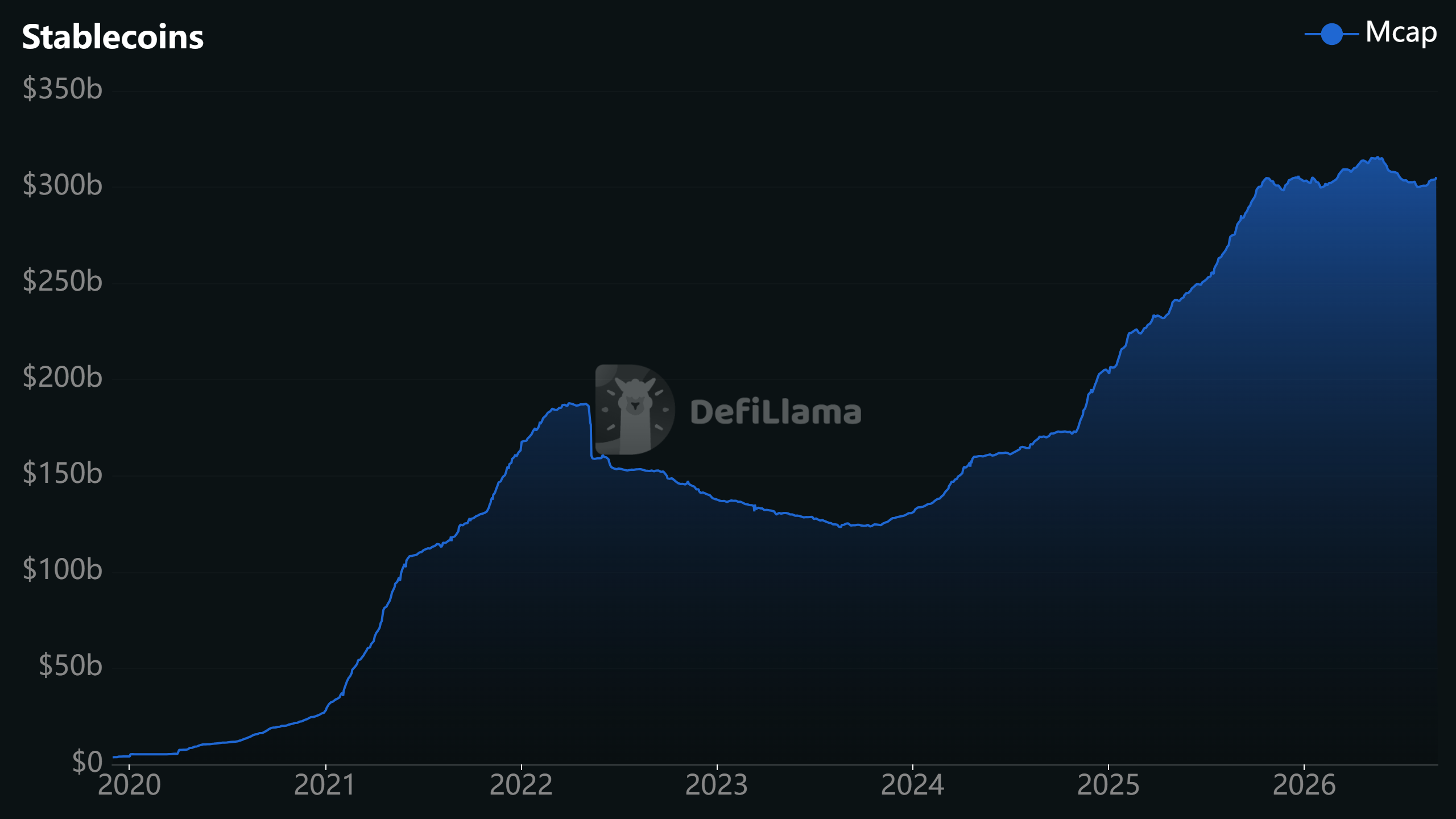
The number of issuers is growing with it, although a reliable total is hard to give because small tokens are constantly appearing and disappearing. What there are hard figures for: under MiCA there are now eight euro stablecoins that meet the requirements, and the wave of bank issuance in June and July 2026 added several serious issuers in a short space of time.
Two developments explain why 2026 is the year this broke through. In the United States, the GENIUS Act introduced a federal framework with requirements on reserves, on redemption and on anti-money laundering. That made it defensible for a bank or a listed company to work with these instruments. In Europe, the transition period for crypto service providers under MiCA ended on 30 June 2026, after which non-compliant stablecoins disappeared from the trading platforms.
What the transaction figures do and do not say
This is where it gets interesting, because this is where most reporting goes wrong.
Raw transaction volume on the blockchain is on course for 40 to 46 trillion dollars in 2026. That is more than the Visa and Mastercard card networks process combined, and that is the comparison quoted everywhere.
Except that figure measures something other than a payment. It counts every movement of tokens: money moving back and forth between trading platforms, automated trading, positions being hedged, and the same dollars changing address dozens of times in a single day. Correct for that and you arrive at very different numbers, and the estimates diverge widely because everyone uses their own method:
- Visa's onchain analytics arrives at roughly 9 to 11 trillion dollars of “organic” volume on an annualised basis, as at early 2026.
- Artemis arrives at roughly 26 trillion dollars a year after adjustment.
- BCG calculated for 2025 that roughly 7 percent of transfer volume is genuine economic activity: 4.2 trillion out of 62 trillion dollars.
Those three figures cannot be reconciled, which makes the picture harder to follow. Because each applies different criteria, the numbers diverge sharply. Estimates of raw volume for 2025 also vary, from 33 trillion to 62 trillion dollars, depending on what is counted.
Drill down to what is unmistakably a payment and roughly 400 billion dollars a year remains. That is modest next to 40 trillion, and it is at the same time the figure that matters most: it doubled in 2025, and it is the part taking place outside the crypto market.
Even so, it is fair to conclude that the stablecoin market is growing remarkably fast and has become a serious alternative to existing payment and settlement methods.
Europe is behind, but growing
Of the entire market, 98 percent is pegged to the dollar. All euro stablecoins together account for roughly 0.2 percent.
There is movement, though. The eight MiCA-compliant euro stablecoins grew from 295.6 million to 673.9 million dollars in a year, an increase of 128 percent. Circle's EURC is by far the largest at roughly 526 million dollars, with a share of around 63 percent. Behind it come EURCV from Société Générale at roughly 137.8 million and EURI from Banking Circle, a Luxembourg credit institution.
That growth is partly a direct consequence of regulation: when non-compliant stablecoins such as USDT disappeared from European trading platforms after 30 June, space opened up that compliant issuers filled.
But the proportion remains what it is. Anyone who accounts in euros and works with stablecoins is in practice taking dollar risk, or accepting a market a thousand times smaller and therefore less liquid.
Where the growth is vulnerable
Three things belong in this story and disappear easily behind the growth figures. The peg is a promise, not a law of nature: Terra showed in 2022 how quickly that can turn. The market is highly concentrated, with two issuers accounting for around 83 percent between them. And because the reserves sit largely in short-dated US government debt, the issuers themselves become a factor of significance in that market. That is not a problem while everything is calm, and it is precisely the kind of connection that only becomes visible when it is not.
Conclusion: the state of the stablecoin market in 2026
The stablecoin market has grown substantially in recent years and stablecoins are no longer something the financial system can do without. Once devised for traders wanting to limit their crypto exposure temporarily, they are now used and issued by the largest banks. Through their speed and low cost, stablecoins offer a serious alternative, and we therefore expect this market to keep growing at pace in the years ahead. With our European base, and euro-denominated funds, we are watching the further growth of euro stablecoins with interest.