


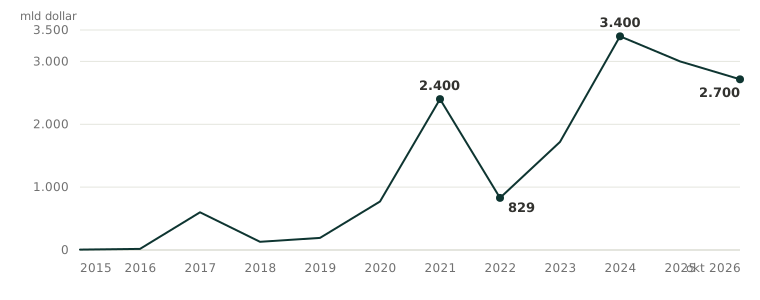
The crypto market was worth around $7 billion in 2015. That is less than 0.25 percent of where it stands today. At the end of 2026 total market capitalisation is around $2.7 trillion.
The number of participants grew just as quickly. Estimates of how many people hold crypto range from 560 million to 741 million, against roughly 420 million in 2023. That spread exists because the studies use different methods, from surveys to on-chain analysis.
Source: CoinGecko annual reports, Capital.com and MacroMicro.
That growth was anything but smooth, and that matters as much as the growth itself. 2018 was a down year, 2022 closed 64 percent lower than it opened, and the market fell again in 2025. In between, though, the market as a whole grew substantially. This is exactly what crypto is known for: its cycles and the volatility that comes with them. Even so, more than 85 percent of the world's population still has no exposure to bitcoin or any other digital asset. Anyone looking at this category is looking at a market that grows and that corrects sharply.
There is a lot of noise about what this technology is good for. The figures quoted are often enormous and say very little, because they count trading flow and transfers between exchanges. The useful question is narrower: where has a blockchain actually been put into production, and stayed there? Let us look at some examples.
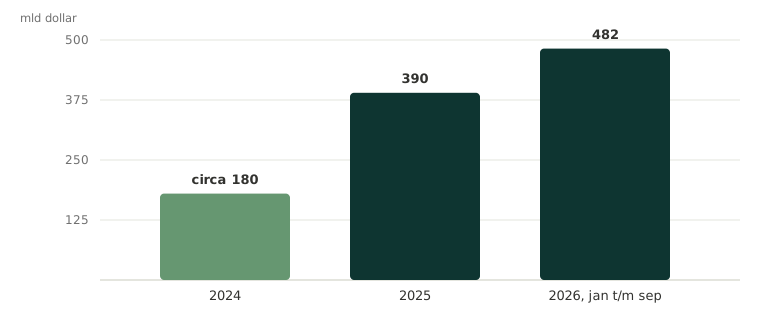
Stablecoins are digital tokens pegged to a currency. Of all stablecoin transfers in 2025, analysis by McKinsey and Artemis put roughly $390 billion down as genuine payment activity. For the first nine months of 2026, Allium counted $482 billion, a 45 percent increase.
Source: McKinsey and Artemis (2026), Allium (September 2026).
The centre of gravity is corporate rather than retail. Of the 2025 total, around $226 billion was business-to-business payments, $43 billion payroll and $28 billion supplier payments. Artemis tracked a set of companies whose monthly volume rose from under $100 million in early 2023 to more than $6 billion by mid-2025. In September 2026 Visa passed an annualised run rate of $20 billion in stablecoin settlement.
Why the growth? Mainly speed and cost. Cross-border transactions are a persistent headache for many companies and individuals, often taking several days and carrying significant fees. With stablecoins the same transfer can settle in seconds at a fraction of the cost.
The clearest sign that this technology is past the experimental stage comes from the banks themselves. Once firm opponents, they have now adopted it at scale. J.P. Morgan has processed more than $4 trillion on its own network, Kinexys, since launch, with average daily volume above $7 billion. The bank says it is aiming for $10 billion a day.
Large international institutions also work together on the Canton Network, among them Goldman Sachs, HSBC, BNP Paribas and the settlement organisation DTCC. Goldman Sachs now runs live delivery-versus-payment settlement on it. Published figures for the total size of that network vary widely and are not independently verified, so we leave them out here.
Trading infrastructure itself is shifting too. Hyperliquid, a decentralised exchange for futures, handled roughly $43.8 billion in volume in the week to 3 October 2026, about 31 percent of all trading on decentralised futures venues. The category as a whole came to $141.5 billion that same week.
Polymarket, where participants take positions on the outcome of events, passed $10 billion in monthly volume for the first time in March 2026. Its US regulated arm recorded $8.8 billion in September and a record of roughly 478,000 monthly active traders in October.
That is real and growing activity, and the nuance belongs with it: this is trading and speculation rather than end-use in the real economy. These volumes say something about the maturity of the infrastructure, not about underlying value. They do, however, represent a serious revenue model for both venues.
The broadest application outside financial services is recording the provenance of products and services. The Aura Blockchain Consortium, founded in 2021 by LVMH, Prada Group, Cartier and OTB, has passed fifty million registered products across more than fifty brands. A handbag or a watch gets a digital passport recording ownership, origin and authenticity, which has obvious value in a sector with a large counterfeiting problem.
In the food chain, Walmart has worked with leafy greens suppliers on a blockchain register since 2018, and Nestle recorded the chain of one of its own products together with Carrefour. These applications exist, but the publicly verifiable results are thinner than in financial services. There is a clear reason for that: value does not come from one party using a blockchain, but from enough parties joining the same network. Where that network effect failed to materialise, projects have stalled, including large ones. The logistics platform TradeLens, run by Maersk and IBM, was discontinued in 2022 for exactly that reason.
The fourth application, recording existing assets as tradable units on a blockchain, is the most interesting one for an investor. We cover it separately below.
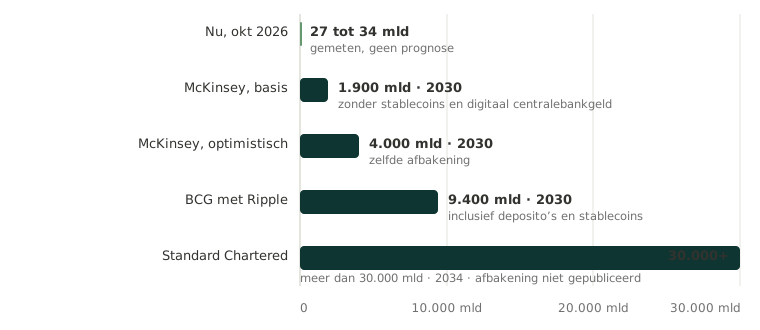
Tokenisation means recording existing assets such as bonds, money market funds and real estate as tradable units on a blockchain. For an investor this is the application closest to home, because it involves familiar products in a new form. Current size is still modest, estimated somewhere between $27 billion and $34 billion.
Source: McKinsey, BCG with Ripple, Standard Chartered, via a16z crypto.
Forecasts for what grows out of that vary widely. McKinsey puts it at about $1.9 trillion by 2030, with an optimistic case of $4 trillion. BCG, together with Ripple, arrives at $9.4 trillion by 2030 and $18.9 trillion by 2033, and Standard Chartered at more than $30 trillion by 2034.
The difference lies mainly in the definitions. BCG counts deposits and stablecoins; McKinsey excludes them. It is worth being critical about the data, but every forecast points in the same direction.
The main advantage of tokenisation is efficiency. Products can be traded faster, around the clock, and transparently. Fractionalisation is useful in some cases as well: shares, for instance, can be divided into smaller units and traded that way.
Institutional participation has risen measurably in recent years. US spot bitcoin ETFs hold more than $100 billion, with roughly $57 billion in net inflows since they launched in January 2024. Goldman Sachs has asked the same question of the same group of family offices since 2021: 16 percent were invested in crypto in 2021, 26 percent in 2023 and 33 percent in 2025.

Source: Goldman Sachs, Family Office Investment Insights (September 2025).
The infrastructure around it is changing too. UBS found that 44 percent of family offices now count crypto as part of their strategic asset allocation, which is something other than an opportunistic position. Deutsche Bank announced a custody service for corporate and institutional clients, and Rabobank recently began offering a bitcoin ETP to investors who pass a knowledge and experience test.
Part of the interest in this asset class comes not from the technology but from a question about what money will be worth over time. Bitcoin was created as an answer to the financial crisis and to the monetary policy of central banks. That view has gained considerable support over the past fifteen years, and it is worth understanding where it comes from.
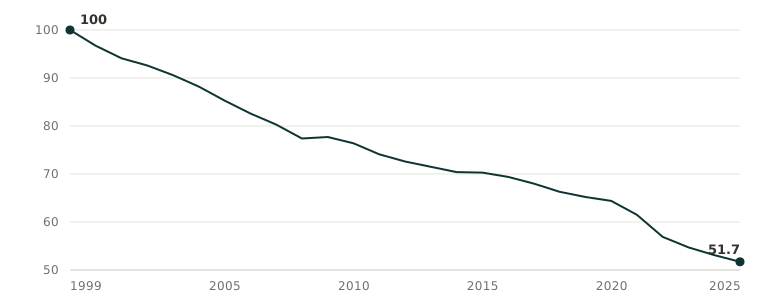
At its core it comes down to money creation by central banks and governments, and the effect that has on purchasing power. According to the US Bureau of Labor Statistics, consumer prices in 2025 were about 1.93 times higher than in 1999. A dollar in 2025 therefore bought roughly 48 percent less than it did then. Central banks themselves are buying gold at a record pace: 288.9 tonnes in the second quarter of 2026 alone, and according to the World Gold Council a record 45 percent of central banks intend to increase their gold holdings further.
Source: US Bureau of Labor Statistics, CPI-U, series CUUR0000SA0.
Set against that is bitcoin. Of the maximum of 21 million bitcoin, roughly 95.7 percent has been mined. Annual issuance of new units currently runs at about 0.83 percent of supply, and halves at the next halving, expected around April 2028, to roughly 0.4 percent.
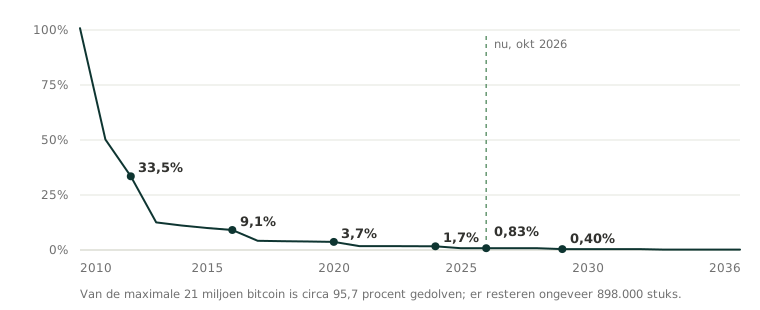
Source: bitcoin protocol emission schedule; block data via Blockchain.com.
That issuance schedule is fixed in the protocol and is independent of demand, price or policy. In that respect it differs from a currency, where the quantity is set by a central bank.
What follows from this is a consideration. Anyone who expects currencies such as the dollar and the euro to keep losing purchasing power may see reason to look at assets where scarcity and independence are built in.
Studies disagree on how many investors allocate, but are strikingly consistent on how much they allocate. UBS arrives at roughly one percent of the portfolio, Campden Wealth likewise, EY at one to five percent and KPMG at under five percent. That is the order of magnitude practice settles on.
An honest account of the risks belongs with that.
Volatility remains substantial. It can work in your favour, but it can equally produce sharp drawdowns. The regulatory framework is also in motion; rules that apply today may differ next year. Holding digital assets carries its own operational risks, including key management.
Based on the data above, the relevant question is not whether this category is growing, but what position fits an investor's horizon, objectives and risk tolerance.
Want to know more about how we do this? Our fund pages set out each strategy, the risks and the fund documentation. The Phoenix Fund and the ZK Fund fall under the supervision of the Gibraltar Financial Services Commission. If you have questions about investing in a crypto fund after reading this page, please get in touch. We look forward to helping you.
Discover our funds

