What is Maple Finance (MPL)?



As Decentralized Finance emerged in the cryptocurrency industry, the first financial instrument which was developed was the borrowing and lending of cryptocurrencies. The ability to borrow capital without a centralized entity was revolutionary and paved the way for other decentralized financial instruments. However, cryptocurrency loans do come with a drawback. As the loans are decentralized, the borrower must provide collateral equal to or greater than the borrowed sum, making it difficult for users to borrow when liquidity is low. Other parties that experience negative effects of this are institutions and organizations.

These entities seek loans in order to improve their operational and financial activities, which will create more revenue and profit in the long run. Thus, providing collateral equal to or greater than the borrowed sum wouldn’t be suitable for their practices.
Maple Finance aims to bridge this gap by providing a capital market for traditional institutions through which they can acquire un- and undercollateralized loans. The Maple Finance platform has attracted thousands of users and has issued almost $2B in loans. As the cryptocurrency market continues to grow in users, traditional institutions will need to have a capital market that grants them loans for their specific needs.
Maple Finance Use Case
Maple Finance use cases are closely related to the inner workings of the capital market. One of Maple’s uses is the ability to earn passive income through their lending pools. If institutions aim to borrow capital from Maple, capital must be provided to the platform. Users are able to deposit the required cryptocurrency in the pool they desire, as a reward they earn extra cryptocurrency through a pre-established APY. For example, the M11 Credit - USDC loan pool offers a 7.96% APY on a 30-Day average.
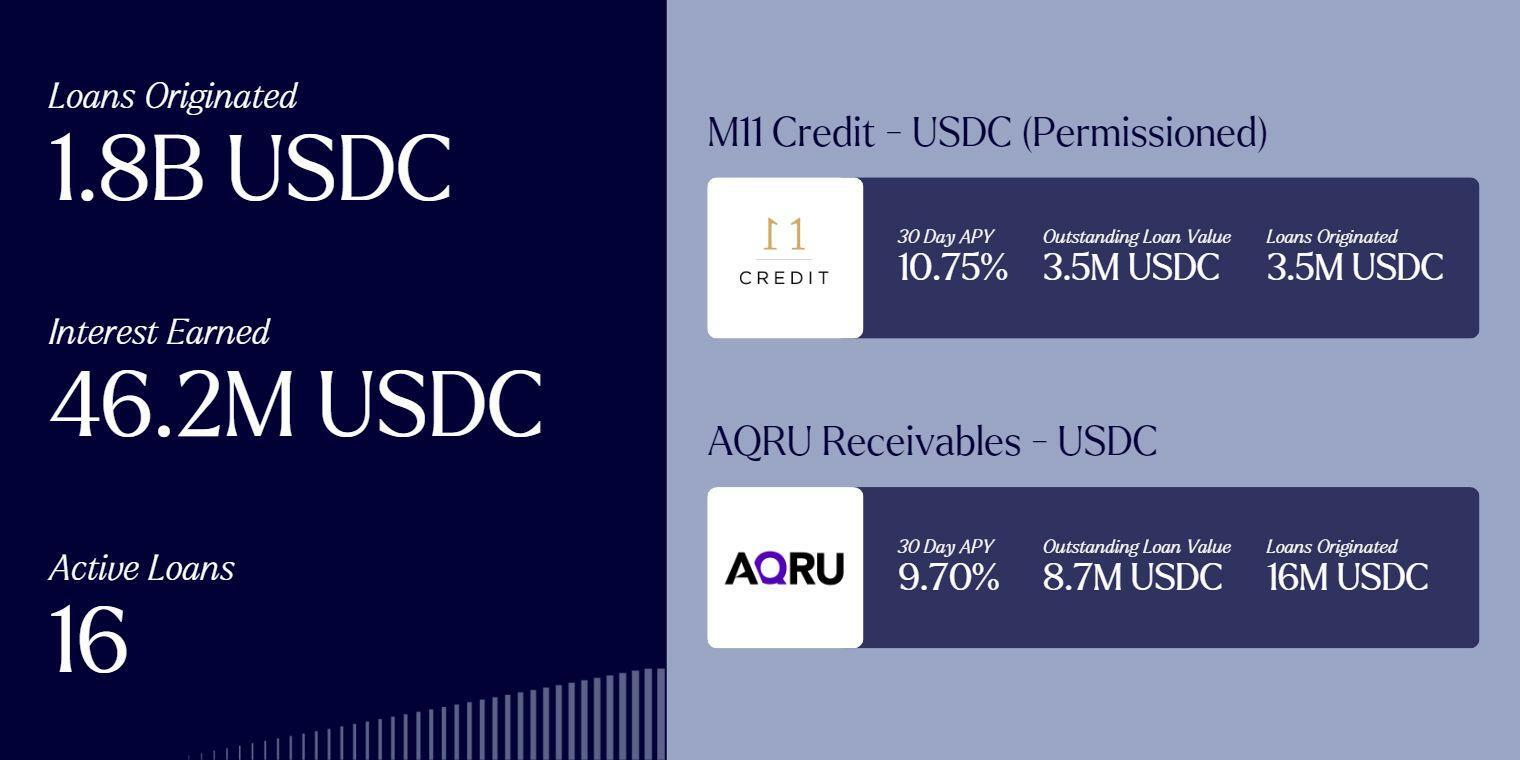
The other core part of Maple Finance is the institutional borrowing pools. Maple Finance has lent out approximately $2B through its various lending pools. Before an organization can receive a loan, it must undergo a rigorous Know-Your-Customer (KYC) process. When the verification has been completed, the institution can submit a loan application. If accepted, a contract will be drawn up and converted into a smart contract.
Maple Finance Ecosystem
Since the launch of the platform, Maple Finance has congregated a trusted and vast ecosystem. A majority of its trusted partners are closely related to the lending and borrowing market of cryptocurrency such as Maven 11, which is a Dutch Venture Capitalist that invested in the platform. In addition, Maven 11 acts as a pool delegate, an entity in the Maple Finance platform that checks loan submissions and is responsible for loan approvals.
Besides a vast network of trusted partners, the platform has amassed a trusted community on its social media channels. Twitter is their biggest social channel as Maple has approximately 22K followers. Aside from the social following, the community of Maple is closely involved with the future of the project as the platform operates as a Decentralized Autonomous Organization (DAO). Users who stake their MPL tokens receive the xMPL token: a representative asset for staked MPL tokens that users can use to vote in voting rounds. These rounds can vary from revenue distribution to improvement of the tokenomics, which grants the community substantial power over the future of the platform.
Maple Finance News
In recent events, Maven 11 Credit, a branch of Maven 11 that focuses on lending, has opened a new lending pool on the Maple Finance platform which will focus on low-latency trading firms. The new pool is a permissioned pool, meaning that the users need to be verified in order to provide capital, and accepts the stablecoin USD Coin (USDC). Currently, the Pool has issued one loan of $3.5M to Flow Traders, a market maker, which needs to be repaid within 60 days at 12.5% interest.

Another event in the Maple Finance platform is the halting of the partnership with Orthogonal Trading, a trading platform that focuses on arbitrage. The company was a pool delegate at the platform and had a proven track record. However, in December 2022, the organization defaulted on its outstanding loans of $36M. The trading firm had quite a decent exposure to the implosion of FTX and has purposefully misstated the exposure to receive loans from the lending pool. As a result, Maple has cut ties with the organization.