


There is no single way of investing in crypto, and the right route depends on four things: the amount you want to invest, the time you want to spend on it, the knowledge you have or want to build, and how you want the assets held. This page sets out every common route side by side, with the advantages and the drawbacks of each. The question of why you would invest in this market is covered separately, on our page on why invest in digital assets.
The table below captures the essentials in one view. The rest of the page explains each route and the differences between them.
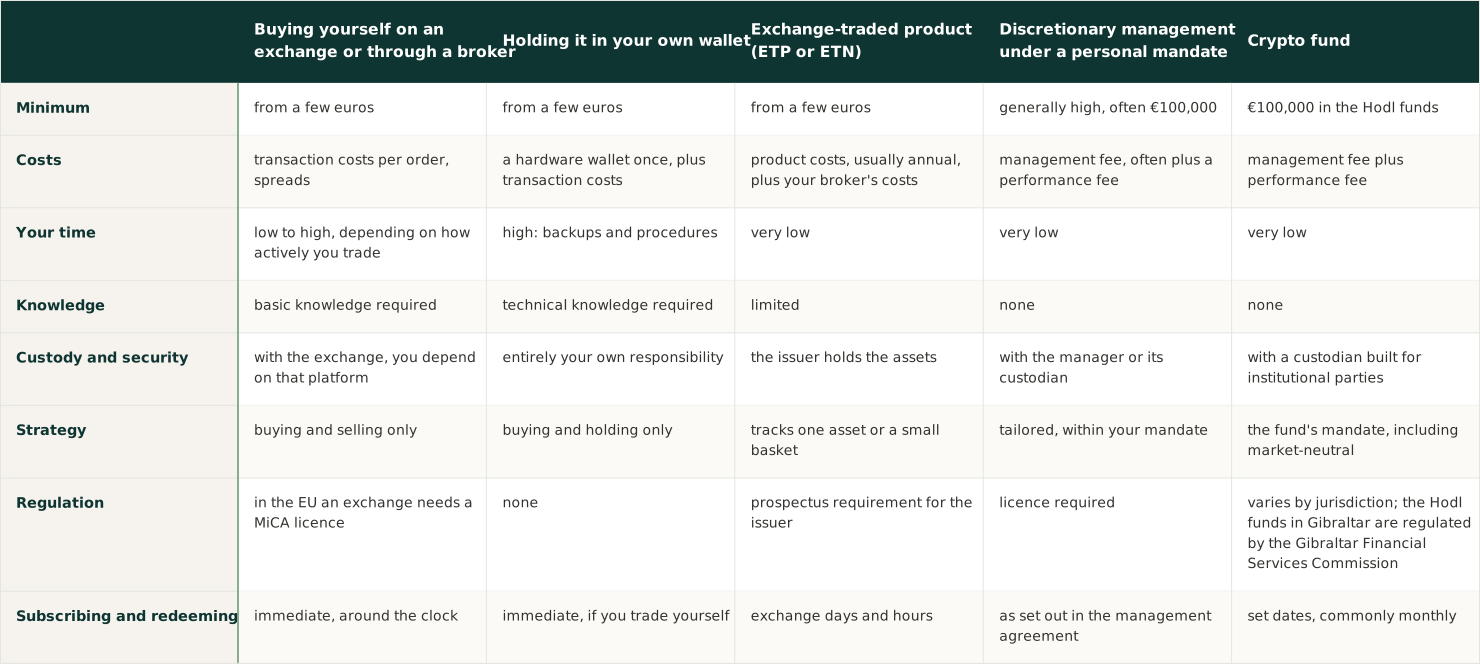
Below we take the five routes one by one.
The most common route. You open an account with a trading platform, transfer money to it and buy bitcoin, ether or another coin. The assets then sit in your account with that platform.
Advantages. You can start with a small amount and buy or sell at any hour. The choice of coins is wide and you can see exactly what you hold.
Drawbacks. You depend on that one platform. If it fails or is hacked, your assets are part of that problem. You also make every decision yourself: what to buy, when to add and when to sell. That takes attention, in a market that never closes.
Who it suits. Investors who want to decide for themselves what they hold, who enjoy following the market, and who are investing an amount they are comfortable placing with such a platform.
A step further is moving your crypto to a wallet you control yourself, usually a hardware wallet. You then hold the keys, which work like the PIN that gives access to your bank account, and with them the assets.
Advantages. No third party can freeze, lose or appropriate what you hold yourself. For many people that is precisely the reason to enter this market.
Drawbacks. The responsibility rests entirely with you, and mistakes are final. Lose your keys and your recovery phrase, the sequence of words that restores the wallet, and the assets are beyond reach. There is no helpdesk and no recovery procedure. It also takes discipline: secure offline backups, in more than one place, maintained for years.
Who it suits. Investors for whom self-custody is a matter of principle, and who are willing to take the procedures seriously.
Through your ordinary brokerage account you buy a product that tracks the price of bitcoin or ether. In the United States these are spot ETFs. That form does not exist in the European Union, because a UCITS fund may not invest in a single asset. A European investor therefore buys an ETP or ETN in practice, and legally those are debt instruments rather than fund participations.
Advantages. No wallet, no exchange account and no minimum investment. The product simply sits in your existing portfolio and trades on exchange days.
Drawbacks. You get no active management: the product tracks its index and makes no choices. And because it is a debt instrument, you have a counterparty. Who that is and how the backing is arranged differs per issuer and is set out in the prospectus.
Who it suits. Investors who want straightforward exposure to bitcoin or ether inside an account they already have. We set out the difference between these products and a fund in our article on what a crypto investment fund is.
With discretionary management you instruct a manager to invest on your behalf within terms the two of you agree. The assets stay in your own name and the mandate is tailored to your situation.
Advantages. The terms are personal. You can set limits that apply to you alone and you have a single point of contact.
Drawbacks. Tailoring costs more than a shared structure, and for crypto specifically the supply of managers is limited.
Who it suits. Investors with a complex situation who want a bespoke arrangement. We do not offer this service ourselves, so it is not something we can help you with.
In a crypto fund you buy a participation in a shared structure. The manager decides the composition of the portfolio and executes the transactions; you own part of the fund rather than the coins themselves.
Advantages. You do not have to manage wallets, keys or exchange accounts. Money goes in and money comes out. The fund's assets sit in a custody environment built for institutional parties, and in a properly arranged structure they are held separately from the manager's own business.
Drawbacks. You pay for that management, you do not hold the assets yourself, you can only subscribe and redeem on set dates, and there is a minimum investment.
Who it suits. Investors who want to allocate a serious amount without following the market or holding the assets themselves. How such a fund is structured is set out in our article on crypto investment funds.
The amount is not the only thing that matters, but in practice it rules things out fastest.
Up to around €10,000. Buying yourself on an exchange, or an exchange-traded product. At this level the fixed costs of management weigh too heavily, and a fund's threshold sits far above your investment. If you want to hold the assets yourself, a hardware wallet is a manageable step.
€10,000 to €100,000. Here the trade-off gets more interesting. You can still buy yourself, but the questions of diversification and custody become more serious. An exchange-traded product offers simplicity with no minimum. Self-custody now genuinely requires good procedures, because this is an amount you do not want to lose through a single misstep.
From €100,000. This is the point at which a crypto fund comes into view, because that is the minimum investment in the Hodl funds. At this level the question shifts from “how do I buy it” to “who holds this, who follows the market, and what strategy is being run”.
Five reasons, and then the other side.
Expertise in house. A fund has analysts following the market daily. Choosing between assets, assessing a protocol and judging where developments are heading take study that you would otherwise do yourself.
Professional custody. Assets are held in offline storage, known as cold storage, as far as possible, and sit on an exchange only temporarily when trading requires it. The keys are managed by people who do nothing else.
Strategies that only work at scale. Market-neutral strategies, for instance, which do not depend on the direction of the market. They require infrastructure and continuous execution, and for an individual they are not feasible or not worth the cost. Hodl has its own trading platform for this, connected to centralised and decentralised exchanges. We explain what market-neutral strategies involve in this article.
Simplicity. Money in, money out. No wallets, no exchange accounts, no key management and no coordination between parties.
No time or technical knowledge required. You do not have to understand the technology or do market research in order to have exposure.
And the other side. A fund charges a management fee and usually a performance fee on the gains. You cannot subscribe and redeem at any moment, only on set dates, commonly monthly. You do not hold the assets yourself, which for some investors is the whole point. And there is a minimum investment, which for the Hodl funds is €100,000.
In short, these are the questions that matter: who holds the assets and are they separate from the manager, what does it cost exactly and are any returns quoted before or after costs, when can you get out, and what is the regulatory status. That last point deserves attention, because it varies a great deal by jurisdiction. Some funds are registered under an exemption, which is not a licence and does not mean there is ongoing supervision. Others fall under a regulator. The Hodl funds in Gibraltar are regulated by the Gibraltar Financial Services Commission.
The answers to all of these are in the fund documentation, the Private Placement Memorandum and the Key Fact Sheet, not on a website. The full checklist is in our article on what a crypto investment fund is.
That differs a great deal by route. Buying yourself or an exchange-traded product can start at a few euros. For the Hodl funds the minimum investment is €100,000.
The crypto market is volatile and you can lose part or all of your investment. That risk does not disappear by choosing a particular route. What does differ is the operational risk: with self-custody it rests entirely with you, on an exchange with that platform, and in a fund with the custodian and the manager.
That depends on where you are resident and on how you hold the assets, and the rules are moving in many countries. We do not give tax advice; have your situation assessed by your own adviser.
In a fund you invest alongside others in a shared structure under a single mandate that applies to every participant. With discretionary management the assets stay in your name and the mandate is tailored to your situation. Tailoring generally costs more; a shared structure is more efficient.
Yes, but not through a fund. Up to around €10,000 the practical routes are buying yourself or an exchange-traded product.
Funds issue and redeem participations on set dates, commonly monthly. So you cannot sell in the middle of the night as you could on an exchange. That cuts both ways: it protects against impulsive decisions, but it also means you cannot respond immediately to a sharp move in the market.
Combining is common. Investors hold bitcoin themselves, for instance, and invest alongside that in a fund running a different strategy, so that each part has its own role in the portfolio.
There is no route that is best for everyone. If you want to follow the market yourself and keep your own keys, buying and holding it yourself is the better fit. If you want straightforward exposure inside an account you already have, an exchange-traded product gets you there faster. And if you want to allocate a serious amount without holding the assets, following the market and arranging execution yourself, you end up at a fund.
We manage crypto funds ourselves, so we are not a neutral party here. That is exactly why it matters that you weigh the advantages and the drawbacks for yourself. If you want to see how we approach it, our fund pages set out each strategy, the risks and the fund documentation.
Our digital assets funds

