ZK Series: What makes the Hodl ZK Fund unique?


For many investors, this is the default way of making money. But what happens when the trend reverses? In many cases, those portfolios fall with it. So how can returns still be generated when prices decline?
In this edition of the ZK Series, we take a closer look at what a robust portfolio looks like, and at the strategies that can continue to generate returns even when markets are no longer supportive.

The Hodl ZK Fund was developed for investors who want to benefit from the opportunities in the crypto market, without being dependent on market direction. Instead of simply “following the price,” the fund focuses on capturing inefficiencies with a clear emphasis on risk control and stability. Below, we highlight what separates the ZK Fund from others.
1. Stable gross annual return target of 20–25%
The ZK Fund has a stable return objective of 20–25% gross per year. In traditional finance, achieving this type of return with a controlled risk profile is difficult, as markets are more efficient and opportunities are competed away quickly.
Crypto, however, is still young, fragmented, and volatile. That combination creates structural opportunities. Because a significant part of the strategy set is market-neutral, the fund is less dependent on rising prices, supporting a more stable return profile within a volatile asset class.
We continuously develop the fund by rolling out new strategies and optimising existing algorithms, with the goal of further improving performance over time.
2. High-Sharpe strategies: attractive returns with less “unnecessary” risk
One of the biggest advantages of the crypto market is that inefficiencies occur more frequently and tend to persist longer than in traditional markets. This makes crypto particularly suitable for high-Sharpe strategies: strategies that aim for an optimal balance between return and risk.
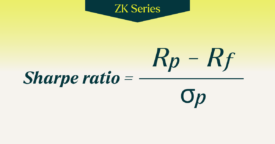
The Sharpe ratio is the most commonly used method to measure that relationship. Put simply: the higher the Sharpe, the more return a strategy typically generates per unit of risk. In a market with asymmetric opportunities—such as price dislocations or funding rate differences—there are many possibilities for these “efficient” strategies.
Within the ZK Fund, we aim for a Sharpe ratio of at least 3.0. Want to understand what this means and why it matters? Read our Sharpe Ratio blog in the ZK Series.
3. Fully in-house developed algorithms and trading platform
A structural advantage of the ZK Fund is its technological foundation. We have been working since 2019 with our exclusive partner Growity, led by our CIO and founder Nick Friedrich. Since then, the team has been building proprietary algorithms on our fully in-house developed trading platform.
The platform is built entirely in Rust, enabling extremely fast execution: orders can be executed in just 15 microseconds (0.000015 seconds). In a volatile environment like crypto, speed can make the difference between capturing an inefficiency and missing the trade.
This long development trajectory has resulted in deep expertise, mature tooling, and a strong base for continuous innovation. Importantly, our technology and trading logic do not depend on external providers, giving us full control, flexibility, and the ability to protect our edge.
4. 24/7 execution across both centralized and decentralized exchanges
Crypto is a 24/7 market, and many opportunities emerge outside “office hours”: during sudden volatility, thin order books, funding spikes, or rapid price differences between venues. The ZK Fund can execute strategies fully algorithmically, allowing it not only to trade continuously, but also to manage risk in real time.
A key differentiator is our ability to operate across both centralized (CEX) and decentralized (DEX) exchanges. This combination creates additional opportunities, such as arbitrage and relative value trades during periods of volatility. The result is an approach that does not rely on one specific type of venue, but instead benefits from the market’s fragmentation.