What do the box 3 changes mean for crypto investors?



On 12 November 2026 the Dutch House of Representatives approved the new box 3 system. Crypto you hold directly will be taxed every year on its increase in value, even if you sell nothing. The same crypto held through an investment fund is only taxed when you sell.
On 12 November 2026 the Dutch House of Representatives approved the new box 3 system. It took a great deal of wrangling and left plenty of tension in the chamber. But what does it mean for anyone invested in crypto?
There are some remarkable changes in there. Changes that will probably get more interpretation in the period ahead; this article works from the situation as it stands at the time of writing. The most striking one? Crypto you hold directly will be taxed every year on its increase in value, even if you sell nothing. The same crypto held through an investment fund is only taxed when you sell.
This article sets out what was decided, what it means in euros and what is not yet settled. It is not tax advice. Have your own situation assessed by your tax adviser.
The new box 3 from 2029: what was decided
The House passed the amending bill that extends the capital gains approach in box 3, the proposal that changes the new system on a crucial point. The accompanying Tax Plan 2027 passed by roll-call vote, 76 in favour and 74 against.
Until now the tax was mainly based on an assumed return on assets above a set allowance (assets of 59,357 euro per person, or 118,714 euro for tax partners). It now shifts to a tax on the return actually generated above a return of 1,800 euro per person, or 3,600 euro for tax partners.
The new amendment sets the rates. From 2029 there will be a top rate of 38.5 percent, starting at 60,000 euro of taxable income from savings and investments per year. Everything below that falls under the regular rate, which goes from 36 to 35.5 percent.
The new system is due to take effect on 1 January 2029. Until then the current deemed-return system, with its counter-evidence scheme, simply continues. So nothing changes for your tax returns over 2026, 2027 and 2028.
One step has not been taken: the Senate still has to give its verdict. Its finance committee asked on 10 November what the consequences would be if the bill is not dealt with until after 1 January 2027. Until the Senate has agreed, this is an adopted proposal and not yet law.
From a deemed return to the real one
Today the Dutch Tax Administration works with an assumed return on your assets as at 1 January. Whether you actually achieved that return is irrelevant, unless you use the counter-evidence scheme to show that your real return was lower.
In the new system your actual result counts. That happens in two ways, and for crypto investors the difference between those two is the whole story.
Under a tax on accrued value the change in value counts every year, whether you sell or not. If your holding rises in value, you pay tax on that in the same year.
Under a capital gains tax the change in value only counts at the moment you sell and realise the gain. Until then nothing happens for tax purposes. Interest and dividends remain taxable annually in both cases.
The change that is easily missed: the tax-free allowance on assets disappears. In 2026 that is 59,357 euro per person. In its place comes a tax-free return of 1,800 euro per person per year. You are no longer exempt because your assets are modest, but only on the first 1,800 euro of return.
Box 3 and crypto: taxed every year on the rise in value
The main rule becomes the capital gains tax: shares, bonds, options and property are taxed on realisation. But a limited number of asset types stay under the accrual tax for the time being. The government names those categories explicitly, and "direct crypto holdings (crypto wallets)" is among them, alongside bank balances, foreign currency, receivables and insurance products.
Crypto in your own wallet or on a trading platform will therefore be taxed every year on its change in value from 2029, even without a sale.
That is meant to be temporary. The House adopted a motion asking the government to submit a bill for a full capital gains tax by Budget Day 2027 at the latest and to introduce it no later than 1 January 2030. During the debate, members pressed for that step to cover crypto as well. But a motion is not a law, so that bill does not yet exist either.
Worked examples: now against later
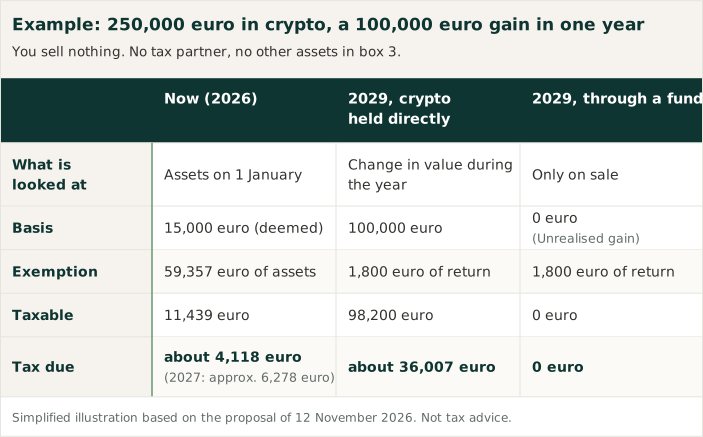
Below is the same portfolio in three situations. The amounts are rounded, the investor has no tax partner and holds no other assets. These are simplified illustrations, not forecasts and not advice.
The starting point: you hold 250,000 euro in crypto and it turns into a good year. The value rises by 100,000 euro. You sell nothing.
Situation 1: now, in 2026
The Tax Administration looks at your assets on 1 January, so at 250,000 euro. The deemed return for other assets is 6.00 percent, which comes to 15,000 euro of assumed return. After the tax-free allowance of 59,357 euro, 76.26 percent of that remains taxable, so 11,439 euro. At 36 percent you pay about 4,118 euro.
The 100,000 euro rise in value plays no part this year. It only counts through the value on 1 January of the following year. If the total value in January 2027 comes to 350,000 euro, the same calculation gives you a tax bill of about 6,278 euro that year.
Situation 2: later, in 2029, crypto held directly
Now the change in value itself counts: 100,000 euro. The tax-free return of 1,800 euro comes off, leaving 98,200 euro taxable. The first 60,000 euro at 35.5 percent is 21,300 euro, the remaining 38,200 euro at 38.5 percent is 14,707 euro. Together about 36,007 euro.
You have sold nothing, so that amount has to come from elsewhere, or by selling part of your position.
Situation 3: later, in 2029, the same amount through a fund
A participation in an investment fund is a financial instrument and falls under the capital gains tax. As long as you do not sell your participation, there is no taxable result from the change in value. This example assumes you keep your investment without realising the gain, so with a fund investment you pay 0 euro.
And the year after that
If the current proposal, and the difference between the accrual tax and the capital gains tax, stays in place, a bad year that follows can work out very unpleasantly for the private investor.
Suppose the price falls back to 250,000 euro in 2030. Your gain has gone, but the Tax Administration's bill still has to be paid. If you invest privately, you pay 36,000 euro in tax, leaving you with a loss on your position. With an investment in a fund, tax is only settled when the gain is realised.
And that is exactly the problem with applying two standards depending on the investment product (buying it yourself versus a fund), which becomes especially clear with a volatile asset class. An annual levy on paper gains sits badly with a market that can move sharply in both directions.
This does not only affect the large investor
The current plan is being sold as a "millionaires' tax". Although the example above involves a quarter of a million, because we offer funds from 100,000 euro, the changing mechanics also have a real impact on people who invest less. And that tends to be skipped over in the debate.
A good year is not exceptional. In the crypto market and on the stock exchange alike, years of 15 to 25 percent come along regularly. The MSCI World, the best-known global equity index, rose by more than 20 percent in 2023 and by more than 16 percent in 2024, measured in dollars. In euros that can work out lower because of the exchange rate. In the crypto market the swings in both directions are larger still.
Below is what such a year means on a self-managed amount of 30,000 and of 50,000 euro, for someone without a tax partner and without other assets; for simplicity we assume the gain is realised. These too are simplified illustrations.
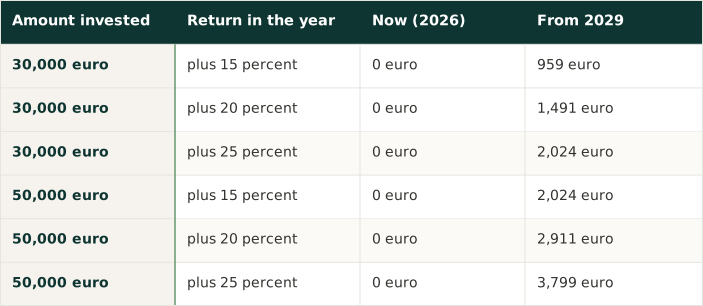
At both of these amounts you pay nothing today, because you stay under the tax-free allowance of 59,357 euro. That allowance disappears. In the new system only the first 1,800 euro of return is free and 35.5 percent comes off the rest. Anyone who falls outside the levy today will therefore receive an assessment in every year in which the portfolio returns more than 1,800 euro.
The money has to come from somewhere
And that is where it hurts. Tax is levied over a year but paid later. By then the gain you are settling up on may have evaporated. You are paying on a peak that no longer exists, with money that has to come from elsewhere: from your savings, from your income, or by selling part of your position at a moment you would rather not.
For someone investing 30,000 euro, an assessment of 1,500 euro is a substantial increase and a real brake on building wealth.
Taking risk is rewarded less
There is an uncomfortable coincidence on top of this. The European Union is working on a savings and investments union intended to move more household savings towards the capital markets, partly through tax incentives for retail investors. On this file the Netherlands moves the other way: those who take risk and put their money into companies will settle up sooner and more often.
Investing is still necessary, and that is the rub
There is something on the other side that weighs just as heavily: doing nothing also costs money, and more than many people think.
According to Statistics Netherlands, inflation in October 2026 was 3.7 percent. Across the years 2021 to 2025 together, prices rose by more than 25 percent. A euro that sat in a bank account in 2020 is now worth about eighty cents: more than 20 percent of purchasing power gone, with 2026 still to be added.
Savings interest does not make up for that. If you receive 1.5 percent on your savings, you fall behind at an inflation rate of 3.7 percent. And in the new system that interest counts every year: above 1,800 euro, 35.5 percent comes off.
An example. An entrepreneur sets aside 150,000 euro for retirement in a savings account at 1.5 percent. That produces 2,250 euro of interest, of which 450 euro is taxable, so roughly 160 euro of tax. At the same time that amount loses about 5,550 euro in purchasing power at 3.7 percent inflation. You are then paying tax on a return that is negative in real terms.
For younger people there is something else at play. Buying a house has become unreachable for many first-time buyers, and investing is one of the few remaining routes to building extra wealth. That is exactly where an annual levy on unrealised gains bites, because what you hand over can no longer grow. Compounding only works as long as the amount stays in the market.
Crypto through a crypto fund: the same investment, a different levy
In a fund you do not buy crypto but a participation. That participation (often also called a share in a fund) is a participation right and counts as a financial instrument, so the capital gains tax applies: tax at the moment you sell. How a fund works is set out in our article on what a crypto investment fund is.
To be fair: this advantage is not exclusive to funds. An exchange-traded crypto product, an ETP or ETN, is expected to count as a financial instrument too and would follow the same regime. The difference therefore does not run between fund and ETP, but between direct ownership and a financial instrument. An overview of all the routes is in how to invest in crypto.
Why we think this distinction is unfair
We manage a Dutch crypto fund ourselves. Put very bluntly, the different treatment of funds would work out well for us: it makes investing through a fund more attractive than doing it privately. But we are far from in favour of this unequal treatment, and we hope the government changes the plan soon.
The government had already received a report from the Council of State, its most important advisory body.
Its Advisory Division names the difference in so many words: the proposed distinction means that holding crypto assets directly will be taxed on an accrual basis, while holding crypto assets through an investment fund will be taxed on a realisation basis. The Division questions whether such a difference in treatment can be justified by appealing to an implementation constraint, and calls the choice to distinguish temporarily between asset types without clear justification "vulnerable".
That goes to the heart of it. The distinction does not follow from a view of how crypto works economically, but from what the Tax Administration's systems can handle in time. The implementation assessment showed that the Tax Administration considered the bill unworkable for 2028 at least, and according to the Council of State the temporary hybrid system requires 252 full-time staff and some 31 million euro in additional implementation costs.
What is not yet certain?
- The Senate still has to agree, both to the amending bill and to the underlying proposal. A majority there is not assured at this point.
- The top rate is conditional. The House adopted a motion asking that differentiation in the box 3 rates only go ahead if the Tax Administration can implement it.
- The step to 2030 for crypto requires a separate bill that does not yet exist.
- Loss relief in the new system determines how heavily a bad year after a good one works out. Will there be any at all?
In short: the direction is clear now, the detail is not. There is no need to overhaul your portfolio straight away, but it is worth taking a moment to know what is coming.
Frequently asked questions
When does the new box 3 start? On 1 January 2029, if the Senate also agrees. Until then the deemed-return system with the counter-evidence scheme continues, so nothing changes for your tax returns over 2026, 2027 and 2028.
Will I pay tax on crypto I have not sold? Yes, if you hold that crypto directly. Direct crypto holdings stay under the accrual tax from 2029, with the change in value counting every year.
Does a crypto fund fall under the capital gains tax? A participation in an investment fund counts as a financial instrument and therefore falls under the capital gains tax. The Council of State confirms that difference in its advice. For your own situation, do have your adviser look at the specific fund structure.
Does this apply to crypto ETPs as well? It is expected to. An exchange-traded product counts as a financial instrument and would follow the same regime.
What are the rates going to be? The regular rate goes from 36 to 35.5 percent. From 60,000 euro of taxable income from savings and investments per year, a top rate of 38.5 percent applies on top. Both from 2029.
Do I need to do anything now? Not on the basis of these decisions alone. There is still a chamber to go and the start is not until 2029. What is sensible: know which regime your holdings will fall under, and go through it with your adviser.
In closing
This article is not tax advice and not an invitation to invest on the basis of tax. We manage Dutch crypto funds ourselves and are therefore not a neutral party in this discussion, but we think it is very important that you know which changes are coming. Have your situation assessed by your own tax adviser.
If you would like to see what the fund route looks like in practice, take a look at the Hodl Genesis Fund or book a meeting.